
Most genealogical research begins with a simple assumption: that life events—birth, marriage, and death—are recorded in a local parish.
And most of the time, that assumption holds.
But in the 19th century, under the Austrian Empire, there existed an entirely parallel system of recordkeeping—one that followed people not by village, but by movement.
These were the military Kirchenbücher (church books), and for many researchers, they represent the missing piece when an ancestor seems to vanish from the records entirely.
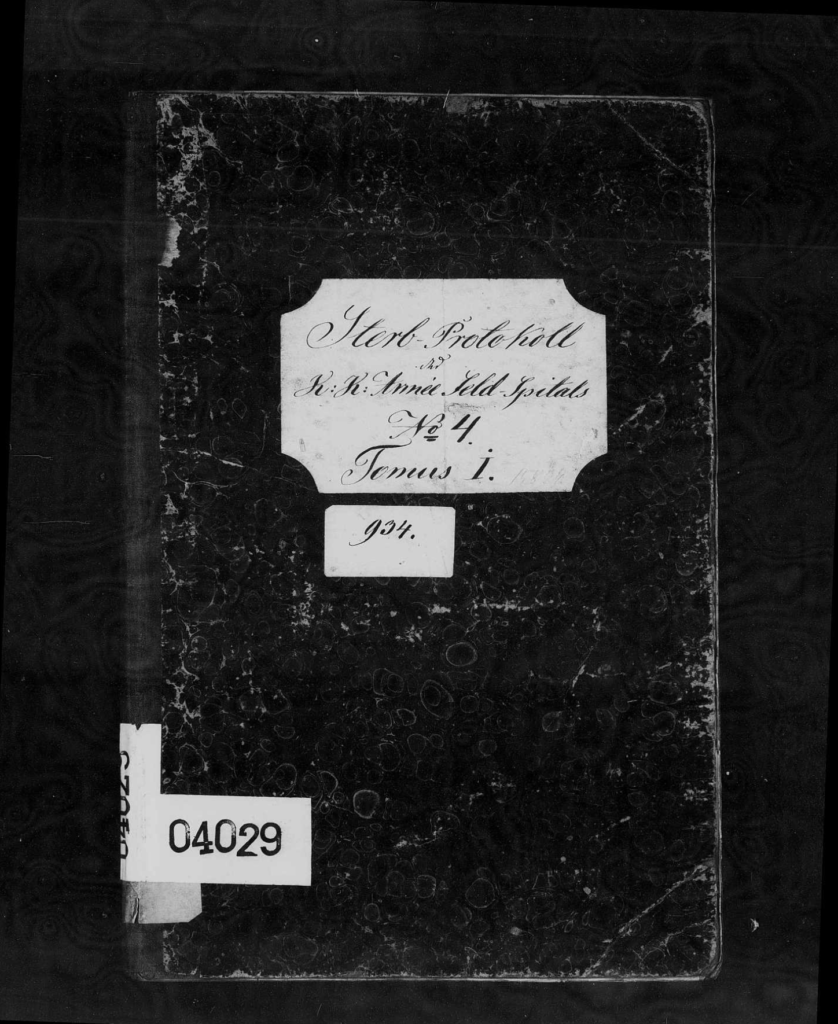
The cover of Feldspital 04 Kirchenbuch, 1859-1862 (image 75)
A Parallel Record System: The Military Parish
The Austrian military maintained its own sacramental registers, commonly referred to as Militärmatriken. These were kept by army chaplains and functioned much like civilian parish books—but within a completely different context.
They recorded:
- Baptisms
- Marriages
- Deaths
These records were maintained within:
- Regiments
- Garrisons
- Military hospitals
- Active campaign units
Rather than being tied to a fixed location, these books moved with the army. In effect, they formed mobile parishes, documenting the lives of soldiers and their families wherever they were stationed.
These records extend well beyond soldiers themselves. You may find:
- Enlisted men and officers
- Soldiers’ wives
- Children born in garrisons or during deployments
- Widows and dependents
- Occasionally civilians attached to military life
What makes them particularly valuable is the diversity of origins. A single volume may include individuals from across the empire—Galicia, Bohemia, Hungary, Croatia, and beyond—reflecting the multiethnic composition of the Habsburg army.
For genealogists, this means one record book can connect places that would otherwise never intersect.
Why These Records Exist
The existence of military Kirchenbücher is rooted in the structure of the Habsburg Monarchy itself.
The army was not just a fighting force—it was a central institution that helped unify a vast and diverse empire. Religion, particularly Roman Catholicism, was embedded in military life, and chaplains were responsible for both spiritual care and official documentation of life events.
Because soldiers were constantly moving—often far from their home parishes—local churches could not reliably record these events. The military solved this by maintaining its own system.
The result is a record set that captures mobility in a way civilian parish books rarely do.
What Makes These Records Unique
Military Kirchenbücher often contain details not found in civilian records, including:
- Regiment name or number
- Military rank
- Place of origin (often critical for identifying home villages)
- Stationing location or campaign context
- Cause of death
Deaths can be highly descriptive. Entries may note whether a soldier died from disease—such as cholera, typhus, or dysentery—or from wounds sustained in service. Hospital records may include specific locations, offering insight into where an individual spent their final days.
In many cases, these records provide more genealogical value than the parish registers they complement.
Language and Format
Like most records in the Austrian Empire, military church books reflect a mix of administrative and ecclesiastical languages.
You can expect:
- Latin (typically earlier records)
- German (typically later records)
Entries are usually structured in columns, similar to parish registers, though marginal notes may include military-specific details. Names may be Latinized or Germanized, requiring some flexibility in interpretation.
When to Look Beyond the Parish
Military Kirchenbücher become especially relevant in specific research scenarios.
Consider them when:
- A male ancestor disappears between approximately ages 18–40
- No death record is found in the home parish
- A marriage appears in an unexpected location
- Children are born outside the known village
- Other records indicate a military occupation
In regions such as Galicia—where conscription was common—these situations occur frequently.
Where These Records Are Today
The primary repository for Austrian military records is:
This archive, part of the Austrian State Archives, holds a substantial portion of surviving military documentation, including Kirchenbücher.
Many of these records have been digitized and are available through FamilySearch with a free account. However, access is not always straightforward. Unlike many parish collections, these materials are often not fully indexed and gaps in coverage are common.
Kirchenbücher exist for:
- Regiments
- Garrisons
- Military hospitals
- Field hospitals
- Other military units
The key challenge for researchers is orientation. To locate a record, you typically need to know where the event occurred and/or which regiment your ancestor served in. Without that, the search can quickly become overwhelming.
A simple search on FamilySearch returns hundreds of collections spread across dozens of pages—useful, but not immediately navigable.
Challenges to Expect
These records are valuable, but they are not simple to use.
Researchers should be prepared for:
- Fragmented and incomplete coverage
- Limited indexing
- Complex regiment tracking
- Language variation and name changes
- Difficult handwriting
- Access barriers, including archive procedures and potential costs
This is not an entry-level record set. But for those willing to work through the challenges, the payoff can be significant.
Example: Following a Soldier Beyond Galicia
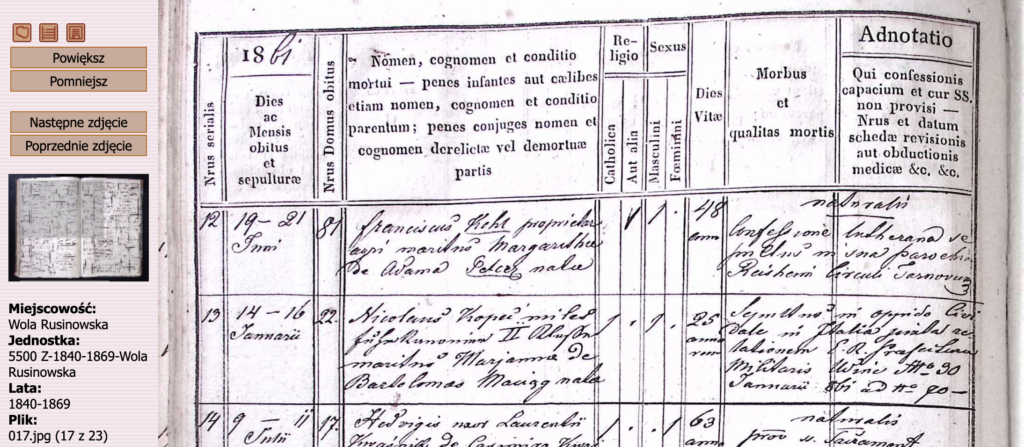
The second death entry on the above page from the village of Wola Rusinowska (act 13) from 1861 immediately stood out to me. Not only was Mikołaj Kopeć the husband of my third great-grand aunt, but there was an unusual note in Latin added to his death record:

“Sepultus in oppido Cividale in Italia, juxta relationem Ex: Praesidii militaris vince die 30 Januarii 1861 ad No. 70.”
Translation:
“Buried in the town of Cividale in Italy, according to a report from the Military Garrison dated January 30, 1861, under dispatch number 70.”
That single line raised an immediate question:
What was Mikołaj doing in Italy?
The answer lies in the broader historical context. Cividale (now Cividale del Friuli) was part of the Austrian Empire at the time. In the late 1850s, Austria was engaged in the Second Italian War of Independence, fighting to retain control over northern Italian territories such as Venetia.
Mikołaj died just two months before the Kingdom of Italy was proclaimed. He was, quite literally, on the front lines of a collapsing imperial border.
To understand more, I searched for military Kirchenbücher from Cividale on FamilySearch. While many years are missing, the key year—1861—survives.
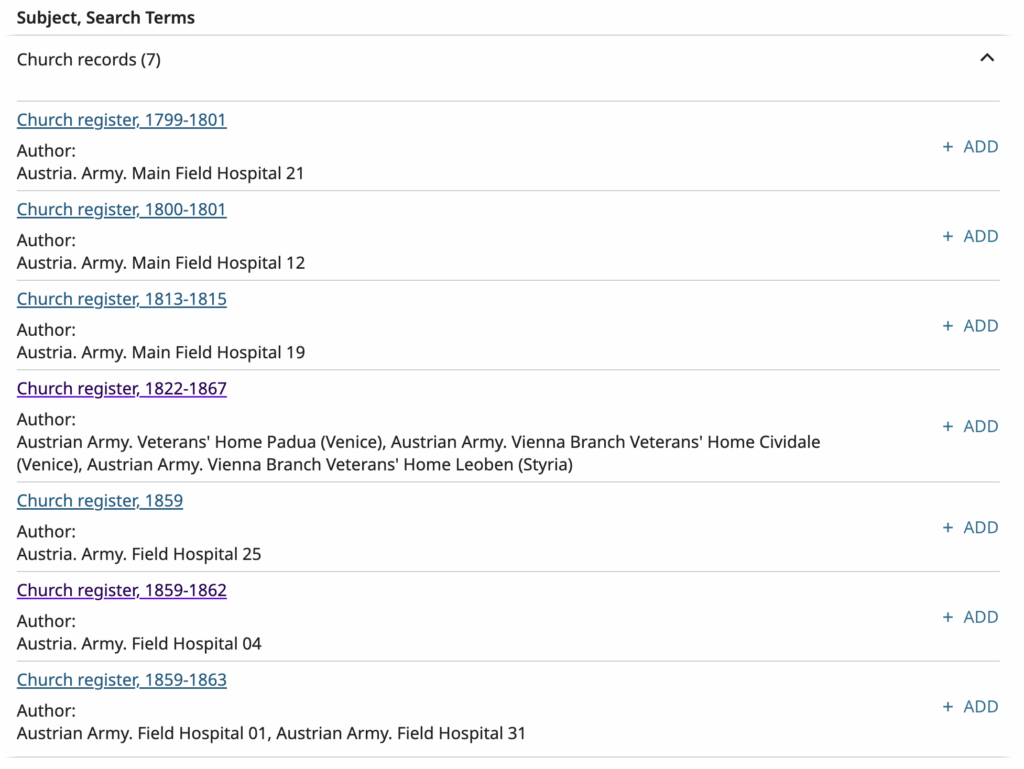
The volume Kirchenbuch 1859–1862 includes deaths recorded at Field Hospital No. 4.
On image 90, his death record appears.
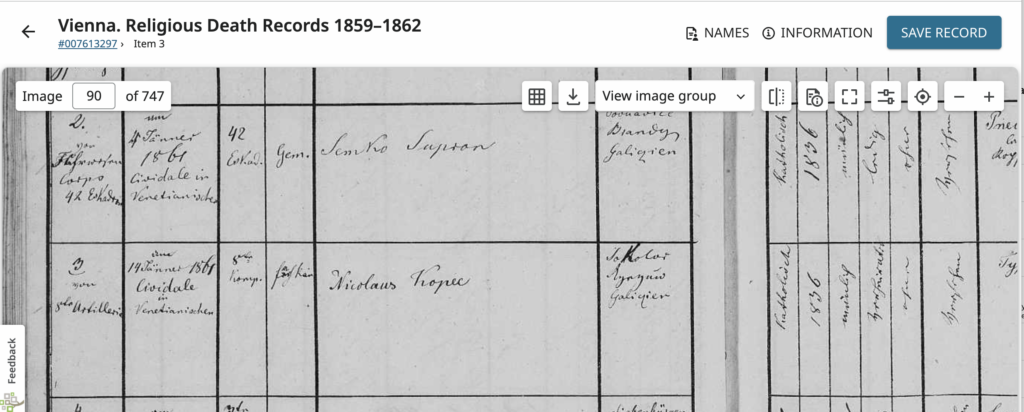
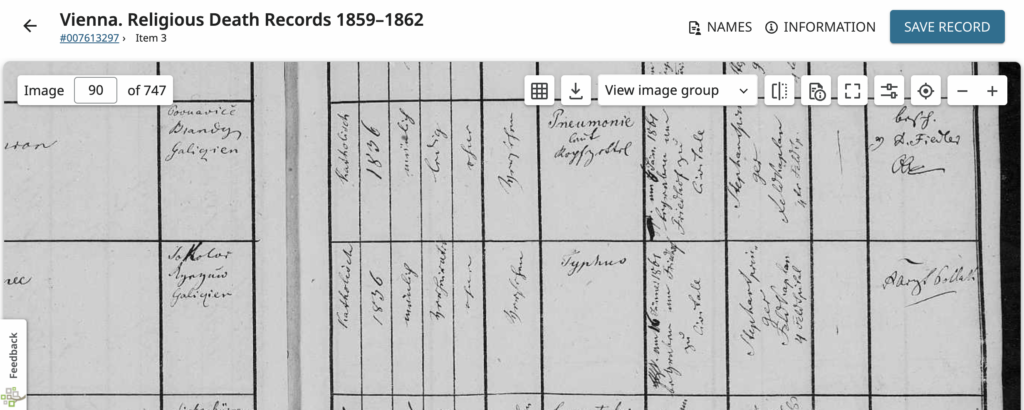
And it is remarkably detailed:
- Regiment: 8th Artillery
- Company: 8th Company
- Rank/Role: Fusilier
- Name: Nicolaus Kopec
- Place of Birth: Sokołów, Rzeszów, Galicia
- Religion: Catholic
- Year of Birth: 1836
- Marital Status: Married
- Death: 14 January 1861, Cividale, Venetia
- Burial: 16 January 1861, Cividale Cemetery
- Last Rites: Administered
- Cause of Death: Typhus
- Clergy: Field chaplain of St. Stephen’s
This record transforms Mikołaj from a missing entry in a parish register into a fully traceable individual—one whose life extended far beyond his home village.
He did not die at home. He died of typhus in a military hospital, far from Galicia, during a period of active conflict.
And like so many soldiers of the 19th century, his death was not from battle—but from disease.
Why They Matter
Military Kirchenbücher fill a critical gap. They reconnect individuals who appear to disappear from parish life. They document movement across vast distances. And they provide a more complete view of how ordinary people lived within—and moved through—the structures of the 19th-century empire.
If parish records anchor a family to place, military records reveal what happens when that connection is temporarily broken.
In genealogical research, absence is often interpreted as loss. But in the context of the Austrian Empire, absence can also mean movement.
And the military Kirchenbücher are where that movement was recorded.
You must be logged in to post a comment.